Gear etiketine sahip kayıtlar gösteriliyor. Tüm kayıtları göster

12 Ocak 2016 Salı

Gear Closet: North Face Ultra Extreme II GTX Hiking Boots

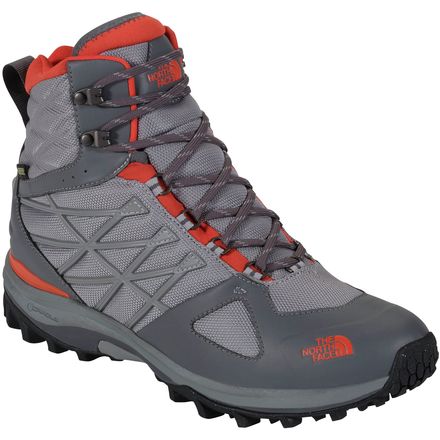
Finding the right boot for winter activities can be a real challenge sometimes. You obviously want something warm and comfortable that can provide good traction on snow and ice, but all too many times that comes at the expense of weight and bulk. That isn't the case with the new Ultra Extreme II GTX boots from The North Face however, as this is footwear designed for the cold and snowy season that doesn't have to make compromises for the sake of performance.

One thing is for certain, these boots definitely know how to make a first impression. Taking them out of the box for the first time, I was struck with just how lightweight they are, but was a little dubious about how well they would perform as a result. The boots look great too, and feature TNF's signature high quality build construction.

Last week I took these boots with me to Utah for a little pre-Outdoor Retailer adventure in the mountains near Park City. With plenty of snow on the ground I figured that would make a great test for this lightweight winter boot. I discovered that they performed better than I expected in most areas, particularly when taking part in winter activities such as snowshoeing and fat bike riding.

The boots feature a Gore-Tex liner that provides not only warmth and insulation, but a layer of waterproofing as well. My winter camping trip began with an evening of outdoor cooking and dinner shared with other writers and media folks, which ended up with most of staying out in the cold for more than four hours. Throughout that time, my feet stayed warm and dry, although by the time we were ready to call it quits for the night, my toes were starting to get a little frosty. But that is to be someone expected when you're standing around in cold weather conditions for extended periods of time. The next day when I set out on the trail for some snowshoeing, my feed remained plenty warm throughout the hike. Better yet, they also stayed dry, despite the fact the snow was quite deep.


Because these boots are so lightweight, they are also incredibly comfortable to wear, even on active excursions. Prior to setting out for Utah, I had only taken them out of the box and worn them around the house for a bit, but that was enough to tell me they wouldn't take long to break in. That turned out to be true, as after only wearing them for an hour or two, they were pretty much ready to go once I reached my destination. By the time I strapped on my snowshoes they already felt completely natural on my feet.

To give the Ultra Extreme II GTX boots plenty of grip on a variety of surfaces, The North Face uses a Vibram Icetrek outsole. This helps the shoes to stay stable in a variety of conditions, ranging from completely dry, to soaking wet, to frozen solid. Hiking in these boots on snow and ice, even without snowshoes, was a breeze, and I never once felt like they weren't up to the task. If anything, the grippy nature of the soles provided more confidence when tackling those conditions.

One of the the things that I like most about these boots is that they don't actually feel like you're wearing boots. The fit and comfort levels are more akin to an athletic shoe, albeit one with lots of ankle support. In fact, the UE II GTX's felt so good on my feet that I didn't bother to take them off for hours after we had left our snowy campground. Because they felt so great on my feet, and provided a nice level of warmth, there was simply no need, even after I had returned to Salt Lake City for the start of the convention.

If you're in the market for a lightweight hiking boot for active winter sports, these boots are more than up to the task, and with a price tag of $150, they are also quite a bargain in my opinion. Winter boots aren't cheap, and a good pair will generally set you back more than what The North Face is asking here. But as comfortable as these are on your feet, and as lightweight as they are in your pack, it is easy to recommend them for anyone who enjoys winter outdoor activities.

That said however, the Ultra Extreme II GTX is probably a bit too lightweight for extremely cold conditions. I used them in temperatures hovering around 20ºF (-6ºC) and had absolutely no problems, particularly when I was on the move. But if the temperatures dropped below 10ºF (-12ºC) I would have definitely wanted warmer socks at the bare minimum, and possibly warmer boots all around. Aside from that however, they performed exceptionally well, and I found myself truly falling in love with them. This is a great boot not just for winter sports, but cooler weather hikes as well, and I have a feeling I'll be getting a lot of use out of them in the weeks to come.

11 Ocak 2016 Pazartesi

2016 Winter Outdoor Retailer Round-Up

This weekend I returned home from the 2016 Outdoor Retailer convention, where hundreds of companies were showing off their latest gear designed to make our lives a lot easier on our adventures. As the name implies, this version of the show is heavily focused on winter activities, such as skiing, snowboarding, and snowshoeing. As a result, much of what was on display is designed to help keep us warm in the cold temperatures, while enjoying our favorite winter sports.

For those who couldn't attend the show, I thought I'd share some of the gear round-ups that have been posted around the web, starting with the ones that I personally wrote over at the Gear Institute. Not only did we publish three show previews (read part 1, part 2, and part 3), we also shared our selections for the best new gear that was on display at the show. Those items were chosen because they brought something, new, unique, and exciting to the gear market.

But we weren't the only ones combing the halls of the Salt Palace in Salt Lake City checking out the new products. The Gear Junkie also posted their picks for the best gear they saw there too, as did Outside magazine, and even Popular Mechanics got in on the act, although I haven't seen their awards selection posted just yet. (Update: Here's the link to the Popular Mechanics awards)

Most of the gear that was shown at OR won't arrive on store shelves until next fall and winter. In some cases the products are still being developed, and they won't be ready to go for a several months. But that means you'll have plenty of time to save your pennies, because a lot of the really great pieces of gear won't come cheap. Still, there are some truly amazing things in the works as our gear continues to get more sophisticated and technical. It is certainly a great time to be an outdoor enthusiasts, as it is now easier than ever to be comfortable and warm, even in harsh environments.

17 Aralık 2015 Perşembe

Gear Closet: Ahnu Ridgecrest Hiking Shoes

I'm lucky enough to get to test a wide variety of outdoor gear here at The Adventure Blog, including a lot of different types of footwear. In the past, I've had the opportunity to test some shoes from some of the biggest names in the outdoor industry, with some performing incredibly well, while others have left me completely disappointed. Recently, I had the chance to test a pair of hiking shoes from Ahnu for the very first time, and while it isn't a brand the is as well known as some of the others I've hiked in in the past, I came away completely impressed by the style, comfort, and quality of their products.

The new Ahnu Ridgecrest light hiking shoe is a waterproof, low-cut boot designed to take on rugged terrain and long distance trails. Unlike some other light hiking footwear that is available on the market today, this shoe is completely capable of taking on a monumental trek such as the Appalachian Trail or something similar. Rugged and durable, I have no doubt that you'll be able to walk hundreds of miles in these shoes before you'd ever need to think about replacing them.

The Ridgecrest features an eVent liner that helps to provide the waterproofing you need to keep your feet warm and dry in damp conditions. That same membrane is also breathable however, which allows heat and moisture to vent out as well. As a result, I found these shoes to be quite comfortable to wear in all but the warmest of conditions. Because they are a low-cut boot however, I'd recommend wearing gaiters with them when hiking in snow or very wet weather, as it will help to keep debris and water from seeping in over the top.


In terms of comfort for your feet, the Ridgecrest delivers as well. Out of the box, I found them to be a bit stiff, but after wearing them for a bit around the house, they soon started to break in nicely. After you've put a few miles on them, you're likely to find that they loosen up nicely, and are easy to walk in. The shoes provide a lot of support for the arch of your foot, and give you a nice sense of balance and control while wearing them. The inner padding helps feels great too, and when combined with an integrated shock-dispersal plate, they do a good job of protecting the foot from wear and tear too.

In terms of traction, the Ridgecrest performed well on a wide variety of terrains. I've worn them on dry trails, through mud, across slippery rocks, and even while fording shallow streams, all without any issues. These boots provide a nice sense of confidence and sure-footedness no matter where you go, and while I haven't had the chance to test them on snow and ice as of yet, I feel fairly confident that they would do fine on those surfaces too, provided it wasn't under extreme circumstances.

Lightweight and form fitting, the Ridgecrest at times feels more like a trail running shoe than a light hiker. That's pretty impressive considering they are made for thru-hiking on rough trails. But their level of performance is outstanding in all areas, which makes them easy to recommend for anyone looking for a low-cut boot that can be used to trek tough routes, or as an approach shoe for mountaineering expeditions. In fact, the versatility that the Ridgecrest offers is one of its strong points, making it a good all around option for adventure travelers, backpackers, and city dwellers alike.

Priced at $150, these boots feel like a real bargain. I've spent more than that on shoes that delivered less. If you're in the market for a new show that can safely and comfortably see you through a lot of outdoor adventures, it is easy to recommend Ahnu's Ridgecrest. They give you everything you could ask for in an outdoor shoe, and more.

16 Aralık 2015 Çarşamba

Gear Closet: The BloomSky Weather Station

As outdoor enthusiasts, the weather often plays a major role in determining when we can and can't go outside to enjoy the activities the we love so much. If you're like me, you probably spend an inordinate amount of time checking the forecast and current conditions to help to determine when is the best possible time to be outside, and just how you should dress for the occasion. At times, you might have even wished that you could own your own personal weather station that could provide updates and information on the conditions that exist right outside your door. Well, if that has ever been something you've dreamed of, than you're definitely going to want to take a look at BloomSky, a device designed to provide accurate weather information and a whole lot more.

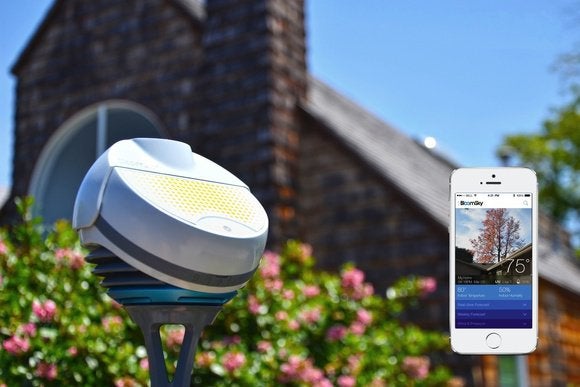
Packed with a host of high-tech sensors, BloomSky is a device that you set up outside your home, office, or other location to record and share weather data. It can detect temperature, humidity, barometric pressure, the current level of UV radiation, and precipitation. That information is than shared directly with you via a smartphone app, which can also be configured to provide alerts based on changing conditions.

As if that wasn't enough, the BloomSky weather station also features a built-in camera, which can be accessed via the app as well. The camera can provide a wide-angle image of the sky or the area that surrounds the device at any given time during the day. Those images are even saved up as the hours pass, providing a nice time-lapse video of how things unfolded from dusk until dawn.

Setting up the BloomSky is a breeze, and takes just a matter of moments. Do to so, you must first download the app to your iPhone or Android phone, and create an account. Once you've done that, you'll be able to manage your devices, giving it its own unique name and configuring a few basic settings. The most important of those settings is granting it access to your WiFi network, which is how the weather station shares its data. That means that when you pick a spot outside, it also has to be within range of a wireless network, otherwise you won't be able to connect to it.


Fortunately, the BloomSky comes equipped with a high quality WiFi chip that seems to have solid range. I configured mine to my wireless router, than took it outside to set up in the yard. It immediately started broadcasting weather data and even some images of my ugly mug up close to the camera as I installed it. The entire process took less than five minutes, and before I knew it my personal weather station and camera system was in place, and broadcasting to the world.

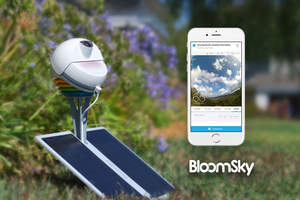
The BloomSky device also features a built-in rechargeable battery that keeps it powered for up to two weeks at a time. But, there is also an optional solar panel that can be connected to the unit to provide a constant source of power. That's the method I've been using to keep my weather station operational, and it seems to be working like a charm. The BloomSky app provides an on-screen indicator of current battery life, and mine hasn't wavered a bit since installing it.

In addition to providing current weather conditions for yourself, there is also a bit of a social element to BloomSky. When you set up the device, you can opt to have its data shared publicly, or make it private so only you see it. Most users are sharing their data, and as a result there is a growing network of BloomSky weather stations across the globe. This gives you the option to search for different locations within the app, allowing you to check the weather in many parts of the world, complete with an image from the camera onboard those other BloomSky devices. To get a sense of where these weather stations are located, take a look at this real-time map that is constantly being updated with new locations. You can also get a sense of where the devices are installed by following the BloomSky Instagram account, which includes some great shots of cameras too.

The BloomSky app is a pretty easy to use, straight forward affair. When launched, it takes you straight to your own device, but also lists other that are nearby as well. Tapping on your personal weather station – or one of the other son the list – gives you more information, including an hourly forecast for the day, and the outlook for the rest of the week, for the place that the device is located. It also allows you to share data via social networking, and gives you the option to save other BloomSky devices to your favorites.

As much fun as having your very own weather station is, the BloomSky isn't without its faults. For instance, the data it provides to you comes in raw numbers, which out of context isn't always helpful. Sure, the temperature and humidity numbers are pretty self explanatory, but barometric pressure is more useful if you know whether or not it is rising, falling, or is stable. I would like to see that option added in the future. The UV radiation indicator was originally a number as well, which meant absolutely nothing to the layman. But now, it has been replaced with a much more useful low, medium, or high rating. Additionally, the app was a bit unstable when I first started using it, but a recent update to fix some bugs seems to have ironed out those issues.

I'd also like to see some kind of history added to the app as well. As it stands, the data is transitory, disappearing as the day goes by. But being able to keep the data and analyze it over time could prove helpful. BloomSky could even grow to the point that it is providing long-term analysis of weather and climate change from across its global network. At this point, that doesn't seem likely though. I also wish that the device had some kind of wind speed indicator and a rain gauge to know just how much precipitation you've had over a certain period of time.

The app also seems to only be available for smartphones at the moment. I'd really like to have it be an option on my iPad as well however. Better yet, I'd like to see a BloomSky app for the new Apple TV as well, allowing me to check conditions and watch the time-lapse videos on my big screen. I'm not sure how likely that is to happen, but it sure would be nice.

That said, there are some nice features about the BloomSky that I really like. I appreciate that it sends me a notification when it starts to rain for instance. I also love the time-lapse videos that it creates each day, and the ability to save them for future viewing should something truly interesting get caught on camera. On top of that, there i something quite satisfying about having your own weather station out in the backyard, providing you realtime data about what is happening around you.

If you have a weather-obsessed person on your holiday shopping list, this would be quite the gift to find under the tree this year. The BloomSky is sold in several different packages, including the basic model which features the weather station by itself. That unit typically sells for $199, but is currently on sale for $149. Additionally, the package that includes the solar panel to power the device typically goes for $337, but is now just $186. That's a heck of deal, and is the one that I would personally recommend, as once it is configured and installed, you can pretty much forget about it. You can see all of the holiday specials, as well as options for mounting the device on a deck, as well as buying the solar panel separately, on the BloomSky online shop.

The bottom line is that this is a unique and fun piece of technology that has a lot of potential. I already enjoy watching the weather from my device, and searching for other stations in different locations around the world. As the product and the app continue to be refined, I think we'll see even more functionality show up from BloomSky, but even now it is a nice option to have at your disposal.

15 Aralık 2015 Salı

Gear Closet: Eddie Bauer Kara Koram 0º Sleeping Bag

We're living in a golden age of sleeping bag technology. Not only have our bags gotten lighter, warmer, and more packable, they now come with a wide variety of insulation types designed to perform better in difficult situations. Case in point, is the 0º Kara Koram sleeping bag from Eddie Bauer, a comfortable, well made product that is designed for cold weather expeditions where space is at a premium and getting a good night's sleep is crucial.

The Kara Koram line of sleeping bags continues Eddie Bauer's recent trend of creating high quality outdoor gear designed for use in the mountains. The company originally made a name for itself back in the 1940's and 50's by making great outdoor gear that was made for use on expeditions to remote places. But over the years the brand became more consumer focused, moving away from the rich heritage that it had in exploration and adventure. However, a few years back, the company launched its First Ascent line of gear, which was an attempt to get back to its roots. That gear was extremely well received, and got rave reviews from those who used it. In fact, some of my favorite pieces of gear that I own are from the First Ascent line, and I have loved everything that I've used. This sleeping bag is a continuation of Eddie Bauer refocusing on the outdoor market, and it delivers on the promise of high quality gear that is built to perform well in demanding conditions.

One of the first things that struck me about the Kara Koram bag was just how well it is built. Every aspect of the sleeping bag screams high quality, from the fabrics used on the outer shell, to the zippers, inner lining, and even the stitching that holds it all together. This feels like a product that can accompany you on many adventures, and come back in perfect shape. That kind of confidence is difficult to find in a lot of outdoor gear, but you'll feel it here.


Packed with 850 fill down, the Kara Koram is incredibly warm and comfortable, while still maintaining the ability to pack down to a surprisingly small size. That means it won't take up much room in your pack, but will still provide plenty of warmth on those cold nights in a tent. I haven't been able to test it at temperatures approaching its 0ºF (-17ºC) rating just yet, but I can attest to the fact that it has exceeded my expectations at every temperature range that I've used it in so far. I have every confidence that it would perform very well at the stated temperature rating, and possibly even lower should the need arise.

We all know that down is warm and provides great packability, but that it becomes all but useless when it it gets wet. That's why the Kara Koram features StormDown, which is Eddie Bauer's name for the water resistant insulation that comes from DownTek, the company that pioneered the hydrophobic down movement. Essentially, the down that is included in this sleeping bag has been treated with a water resistant coating that allows it to repel moisture, while maintaining its loft and ability to keep us warm. It is truly a revolutionary product, and I'm happy to say that it is put to good use here. For this bag to fail in the same manner as older down sleeping bags, conditions would have to be incredibly bad.

Getting a good night's sleep is imperative to enjoying your time in the backcountry, and this bag will help you to do jus that. Its interior is very comfortable, and while it does feature a mummy-cut design, I never felt cramped or claustrophobic inside. The designer at Eddie Bauer were even thoughtful enough to include an interior pocket for storing your electronic devices. This has the two-fold benefit of keeping those items close at hand for when you need them, as well as keeping them warm in cold conditions – something that can help with maintaining battery life and protecting LCD screens.

As with any mummy bag, the hood plays an important role in keeping you warm throughout the night, and the Kara Koram is no different. Fortunately, I found it easy to cinch up the hood, and still sleep very comfortably. But if you're the kind of person who finds this style of sleeping bag confining, you may have issues here.

For those who are concerned about how much their packs weigh when setting out on an adventure, the Kara Koram tips the scales at 2 lbs. 12 oz for the regular version, and 2 lbs. 15 oz for the long. While that doesn't make it the lightest sleeping bag on the market of course, those are still impressive numbers for bag that is rated for 0ºF. Winter gear is always heavier and bulkier than what we can get away with during the warmer months, but all things considered, this sleeping bag provides excellent performance for its weight and size.

Of course, any piece of gear that offers this level of performance tends to come with a steep price tag, and the Kara Koram 0º is no different. MSRP for this sleeping bag is $549, although it can be found online for less if you search hard enough. That price will probably be enough to put some people off, but good winter gear always costs more, and you'll be hard pressed to find a bag that performs this well for less.

As you can tell, I'm highly impressed with this bag. If you need something for cold weather adventures, I'd recommend it highly.

9 Aralık 2015 Çarşamba

Nat Geo Presents Holiday Gifts for the Adventurer in Your Life

Now that December is here, the holidays are just around the corner, which probably means that you're searching for the perfect gift for the outdoor enthusiast or adventurer in your life. Why not let National Geographic help you find just the right thing to put under their tree this year?

Nat Geo has just published it's holiday shopping guide for 2015, with some great suggestions that are sure to be popular with your outdoor explorer. Some of the products that get the nod include the Pace Norviz Reflective Top from Helly Hansen, which is zip-necked activewear top that becomes highly reflective in low light conditions. The Danner Jag Steel boot is recommended for its retro look, comfort, and lightweight, while the Filson Meridian duffle is a great option for use on those short, weekend escapes. Other gift options include new running shoes from New Balance, a down-insulated pull-over from Patagonia, and an ultralight stuff pack from Osprey.

You'll find items on the list for every budget and lifestyle, ranging from high end watches and cameras, down to simple – but highly useful – items that don't cost much at all. Most of the items on the list will definitely be highly coveted by the outdoorsman or woman in your life, and will provide them with something that will be of use for many years to come.

If Santa is reading this blog post, I'd certainly enjoy finding the new Suunto Traverse under my tree this year. That, and a puppy.

North Face Founder Doug Tompkins Dies in Kayaking Accident in Chile

There is sad news for the outdoor adventure community today as it was announced last night that Doug Tompkins, the founder of The North Face, has passed away in a kayaking accident that took place in Chile. He was 72.

According to reports, Tompkins was on a kayaking trip in the Patagonia region of South America. He, and several others were paddling across General Carrerra Lake in high winds and strong waves, when six members of the team, including Tompkins, capsized. They were all waters that were below 40ºF (4ºC) for an extended period of time, which led to Tompkins eventually passing away due to extreme hypothermia.

Doug founded The North Face back in 1964 as a local gear retail shop in San Francisco. Later, he would also found the Esprit clothing company as well. Both would grow into billion dollar empires. Tompkins retired from the business back in 1989, and moved to Chile where he purchased thousands of acres of land, both in that country and Argentina. Most of that land was turned into a private nature reserve to help keep the Patagonia region free from developers.

Tompkins' legacy will of course be The North Face, and his important work in conservation. But in 1968 he was part of a four-man team that spent six months traveling to Patagonia and climbing there. He and the team put up a new route on Fitzroy, and documented their efforts in books and films. One of the other members of that squad included Yvon Chouinard, who would go on to form Patagonia and also go to great lengths to help preserve the natural landscapes of Chile and Argentina.

None of the other members of Tompkins kayaking team were seriously injured in the accident. Unfortunately, he succumbed to hypothermia in the intensive care unit of a Chilean hospital. I wish to extend my sincere condolences to Doug's friends and family. He will certainly be missed.

8 Aralık 2015 Salı

Gear Closet: Jöttnar Fenrir Hydrophobic Down Jacket

One of my favorite advances in the area of outdoor gear over the past few years has been the introduction of water-resistant down. Before the creation of this type of insulation, anytime a down jacket or sleeping bag got wet, it became practically useless. Wet down loses its loft, becomes clumpy, and can even freeze solid. But with this new type of down insulation that isn't the case, and an increasing number of companies are incorporating it into their products, improving the overall performance in the process. Case in point, the Fenrir jacket from Jöttnar, which uses Downtek insulation to create a warm, lightweight outer layer that is built for alpine pursuits.

If you're not familiar with Jöttnar just yet, it is probably because the U.K.-based company is still relatively new on the scene, and hasn't made a big impact on this side of the pond just yet. But they're hoping to change that in the near future, and considering the line-up of outdoor performance gear that they offer, I think you'll probably be hearing a lot more from them in the future.

The Fenrir is one of the company's flagship down jackets, and is a good example of their approach to design gear for use in extreme conditions. Lightweight and highly packable, the jacket weighs a mere 13.2 ounces (380 g), but offers a level of performance that you might find in a heavier, bulkier product. Stuffed with 850 fill power down, Jöttnar has placed its water-repellant insulation in strategic areas throughout the jacket to help make it as efficient and comfortable as possible. As a result, the Fenrir has been designed to provide protection where it is needed most, without becoming overly bulky.

In fact, one of the things that I like the most about this jacket is its athletic cut and design. This is a precut that has been designed with outdoor athletes in mind, and as a result it hugs the body closely, providing a fit that doesn't impede movement in any way, but also ensures that the warmth is kept inside, close to the body where it will do the most good.


The outer fabrics of the Fenrir include rip-stop nylon that has been designed to keep the howling winds at bay. Those same fabrics are also water resistant and treated with a DWR coating that will repel just about anything short of a serious downpour. That helps to keep the Downtek insulation inside the jacket from getting overly wet as well, even though it is capable of staying dry for up to 10 times longer than traditional down as well.

Other features that are much appreciated include an interior pocket large enough to hold a smartphone, two hand-warming pockets on either side of the jacket, and elastic cuffs that were specifically designed to help keep the heat in. Drawcords along the bottom of the Fenrir allow the wearer to dial in just the right fit, and those same cords have been engineered to avoid snagging them on external objects while on the move.

As someone who is a frequent traveler, one of my favorite features of this jacket is its ability to pack down to a very small footprint. Jöttnar even includes a stuff sack along with the Fenrir that allows you to store the jacket until it is needed, without taking up too much room in your backpack. This will come in handy on many future trips where a warm jacket is needed, but you won't want to sacrifice carrying capacity.

When used as part of a layering system – consisting of base layers, a mid-layer, and an outer shell – the Fenrir truly comes alive. This is a warm, comfortable, puffy jacket, without too much of the puffy part. The fact that it also features a classic, simple, but elegant, design makes it easy to wear around town on cold weather days without feeling like you're out of place. But the Fenrir was designed for performance in the mountains, and that is where it truly shines. The jacket will keep you warm on the trail in incredibly bad conditions, allowing you to keep moving without compromise. What more could we possibly ask for out of our gear?

Jöttnar sells the Fenrir for £200, which roughly translates to $300 at the current exchange rate. That's a relative bargain for a jacket that performs at this level, and offers so much versatility. The biggest challenge you're likely to have is tracking one down here in the States or in North America in general. Hopefully that will change soon, as this is certainly a brand to keep an eye on, and their gear is top notch in every way.